ITINERARY
::
DAY 01:
FLIGHT FROM KATHMANDU TO LHASA ( 3,656 meters)
-- DRIVE TO TSEDANG ( 3100 meters)
Today , you will be transferred to the TIA international airport in Kathmandu to
board the plane to Lhasa. You will take a breath taking trans Himalayan flight
over the Mt. Everest (8848.48 meters) towards Lhasa. Upon your arrival at the
Gonggar Airport in Lhasa, be welcomed & received by our airport
representative. Drive (183 km) towards Tsedang town. Check into your hotel in Tsedang.
Balance of the day is at your leisure for
the acclimatization. Overnight at the hotel in Tsedang.
DAY 2 : EXCURSION IN TSEDANG -- DRIVE TO LHASA ( 3,656
meters)
Conveniently after the breakfast, proceed for the sightseeing tour in Tsedang .
Visit the monumental zones of “ Samye
Monastery “ , “ Yumbu Lha Khang Palace “ and the “ Tandruk monastery ”.
Later , continue the driving journey ( 158 km / 3 Hours ) towards Lhasa. On arrival in Lhasa, get transferred to your
hotel and check in. Overnight in Lhasa.
[ Samye Monastery : Samye Monastery was
founded in the 8th century during the reign of King Trisong Detsen with the
help of the Indian Buddhist masters Padmasambhava and Shantarakshita, whom the
king had invited to Tibet to help spread Buddhism. Padamasambhava is credited
with subduing the local spirits and winning them over to Buddhism. The first
Tibetan monks were ordained here after examination, and are referred to as the
Seven Examined Men. Over the centuries Samye has been associated with various
schools of Tibetan Buddhism. Padmasambhava’s involvement makes Samye important
in the Nyingma School, but it was later taken over by the Sakya and Gelugpa
schools. Today, Tibetans of all traditions come to worship here.
Yumbu Lha Khang Palace : Yumbu
Lha khang is oldest palace & the oldest monumental structure in Tsedang. Mythological beliefs say that King Nyatri
Tsenpo descended from heaven to build this palace in
2nd century BC. Myths say it
is the founding of Tibetan civilization. This palace is constructed at the
perfect crest of the hill divided into three different components; the tower,
the chapel and monks quarters.
Tandruk Monastery : Not very far from Yumbu Lha Khang, Tandruk
Monastery is situated at the road side. Tan means ‘rock’ and druk means
‘dragon’ in Tibetan. The monastery got its name from the legend that it could
only be built after Songtsan Gampo had turned into a rock and conquered an evil
dragon. It’s said that renowned figures in the history of Tibetan Buddhism,
such as Padmasambhava and Milarippa, had practiced Buddhism nearby after it was
built and the remaining relics are Sacred for the devotees. ]
DAY 03 : EXCURSION IN LHASA ( 3,656 meters )
Conveniently after the breakfast, proceed for an excursion to the magnificent
heritage sites of “Potala Palace”. Take a lunch break in between the tours. Then
continue your excursion to the “ Jokhang Temple” and the “Bharkor local market”.
Return to the hotel. Overnight in Lhasa.
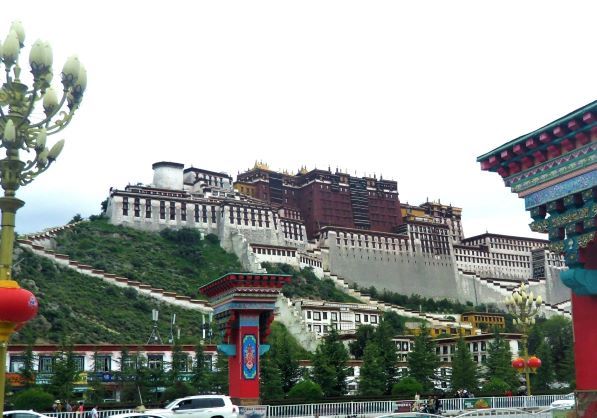
[ Potala Palace
: This is situated on the red rock hill
in the central Lhasa. Potala Palace is the highest ancient palace in the world,
reaching 3,767.19 meters at the topmost point.
The word Potala was derived from the Sanskrit language and translate to
the meaning "Abode of the Awalokiteswora ( God Of Compassion)." Legend has it that in the 7th century, to
greet his bride Princess Wen Cheng of the Tang Dynasty (618B.C. - 907B.C.) of
China, then great Tibet King “ Shrongtseng Gompo” built a 9 storey palace with a thousand rooms
up on the Red Hill and named it Potala. Later, with the collapse of the “
Songtsen Gampo Dynasty” , the ancient palace was almost destroyed in wars. What
we see at present is the architecture of the Qing Dynasty (1644B.C. - 1911B.C.)
and the continuous expansion of the re-construction work and its outcome since
the 17th century.
Jokhang Temple : Jokhang temple was build
by: Great King Songtsem Gampo (617 – 650
AD , the 33rd king of Tibet) and it is Included on UNESCO's World Heritage list
in 2000 AD as a part of the Potala Palace, the Jokhang Temple is located in
central Lhasa. With an area of 25,100 square meters (about six acres), it is
the ultimate pilgrimage destination for Tibetan Pilgrims.
Bharkhor
Local Market : Located just
outside to Jhokhang Temple , this charismatic & the lively local market
surrounds the entire periphery of the Jhokhang Temple an enrich the environment
of the entire temple complex. The circular route of this oldest street in the
heart of the city dating back to the foundation of the Jokhang temple itself.
This is also a market where you can hang around in the evening time.]
DAY 04 : EXCURSION
IN LHASA ( 3,656 meters )
Conveniently after the breakfast, proceed for an excursion to the magnificent
heritage sites of “ Drepung Monastery” and the “Sera Monastery”. Take a lunch break
in between the tours. Then continue your excursion to “ Norbulinkha Palace”.
Return to the hotel. Overnight in Lhasa.
[ Drepung
Monastery
:- The monastery was established in 1416 AD by Tsong Khapa's disciple Jamyang
Qoigyi, Situated at the foot of the Mountain Gambo Utse, five (5 ) kilometers
(3.1 miles) from the western suburb of Lhasa, the Deprung Monastery is known as
the most important monastery of Gelugpa in Tibetan Buddhism.
Sera Monastery :- Located at the foot of Tatipu Hill in the
northern suburb of Lhasa City, Sera Monastery is one of three famous
monasteries in the city along with the Deprung Monastery and the Ganden
Monastery.
It is dedicated to the Gelugpa or Yellow Hat Sect, a branch of Tibetan Buddhism,
founded by Tsong Khapa. Jamchen Chojey, one of Tsong Khapa's disciples built it
in 1419AD during the Ming Dynasty (1368-1644)AD. The monastery was named “Sera”
which means “wild rose” in the Tibetan language, because the hill behind it was
covered with wild roses in bloom when it was built.
Norbulinkha Palace :- Norbulingka Palace, on the west edge of Lhasa
city is the biggest manmade garden in Tibet Autonomous Region. Norbulingka, in
Tibetan, refers to “Park of Treasure” and used to be the summer palace of Dalai
Lamas to deal with government issues and hold religious activities. Built from
1755AD and under the reconstructions of
different Dalai Lamas, Norbulingka expands its scale into over 360,000 square
meters and more than 374 rooms, including palaces for 7th to 14th Dalai Lamas.
Dotted with various kinds of precious flowers and plants, it is the genuine
“Plateau Oxygen Bar”. With peaceful atmosphere and tranquillity ,you will
easily get yourself relaxed when walking inside this pure land. As one part of
the historic Ensemble of the Potala Palace, it was added to World Heritage
Sites in 2001 .]
DAY 5 : DRIVE
FROM LHASA TO GYANTSE
( 3,977 meters )
Conveniently after the breakfast, proceed for the driving journey to Gyantse. Today,
the trip starts from a visit to “Drolma Lhakang Temple”, situated in the
highway to Gyantse. Continue the journey further ahead and
you will arrive at the turquoise lake of “Yamdrok Tso” which is famouse for its
Scorpion shape and turquoise blue coloured clean water. From a vantage point in
the “Khampa-la Pass” (4794 meters) , one
can have a panoramic view of this beautiful lake.
Later, continue the journey by passing over the “Brahmaputra River” (Yarlung
Tsangpo) and after a 2 hours of driving, you will arrive at Gyantse town. Check
in to the hotel in Gyantse. Overnight in Gyantse.
[ Drolma Lhakang Temple : This is situated
west of Lhasa about 25km on the way to Gonggar Airport. This temple might seem
small and ignored by tourists but this temple is where the greatest Bon-Po
master Atisha spent the last years of his life. This temple is of Drolma or
Tara, a famous female bodhisattva.
Yamdrok
Tso Lake : This scorpion shaped picturesque lake is
situated at a distance of an hour of driving from Lhasa. You will reach the
foothills of Kampa la pass. From here you will have your best views of Yamdrok
Lake , its sky blue water & also the snow capped mountains on a sunny
winter morning. ]
DAY 6 : DRIVE
FROM GYANTSE TO SHIGATSE ( 3,840 meters )
Conveniently after the breakfast, proceed for the sightseeing in Gyantse. Visit
to the 2 impressive Buddhist monuments at “ Khumbum Stupa and Pelku Chode
monastery”.
Later proceed for the driving journey ( 95 km / 2 hours ) to Shigatse. On
arrival in Shigatse check in to the hotel. Later, proceed for the sightseeing
at Panchen Lama’s “Tashilunpu Monastery”. Return to your hotel. Overnight in
Shigatse.
[ Kumbum Chorten Stupa : The
octagonal shaped, 9 stories white stupa, 42.4 meters high chorten situated in
the periphery of the Pelku Chode monastery is known as “ Kumbum Stupa”. Kumbum
means 100,000 images in Tibetan language hence this is colloquially also known
as “ One-Hundred-Thousand-Buddha Tower
”. The first Khumbum was founded in the year 1427 AD by a Gyantse prince. It
has nine Lhakangs or stories & is 42.4 metres high surmounted by a golden
dome, and contains 77 niches/ chapels which line its walls. At the higher
levels you can go out to an outdoor terrace and enjoy an incredible view on the
town, monastery and surrounding fort.
Pelku (Palcho) Chode Monastery :- This
is the main Buddhist monastery in Gyantse. It was completed and consecrated in
1425 AD. -- The monastery treasures 1,049 sets of ancient Tibetan sutras which
are most valuable for studying Tibetan religion and ethnic cultures. The
monastery has 17 Datsans (colleges, a unit of religious organization in a
monastery) in total in this monastery, which belongs to the Sakya (the major
monastery is Sakya Monastery), Kagyu and Gelug (the major monastery is Ganden Monastery)
sects of Tibetan Buddhism. It is really rare among the Tibetan monasteries that
several sects could coexist under one roof.
Shigatse Town : This town
is situated near the junction of the “Ngang” and “Yarlung Tsangpo”
(Brahmaputra) rivers, with many traditional low ceiling, flat roofed, mud brick
Tibetan houses, but quite a lot of ugly modern Chinese buildings as well. It is
home of the “Tashilunpo Monastery”, traditional seat of the Panchen Lama, and
one of the great centres of Tibetan Buddhism.
Shigatse has an interesting local bazaar, where various traditional
items can often be found at more or less reasonable prices. This town has always been an important trade
and administration centre and also has political and religious significance,
once being the seat of the Panchen Lama. The town is essentially divided into
two parts: the old Tibetan style area in the city and the concrete, modern
Chinese part of the town. The older streets and alleys here are very pleasant
to wander around and there are a few sights of interest to guarantee a stay of
minimum of two days.
Tashilunpo Monastery : The monastery located on a hill in the center
of Shigatse city, the name “Tashi Lhumpo” translates to the meaning " All
fortune and happiness gathered here" or " Heap of Glory".
It was founded in 1447 by the 1st
Dalai Lama, is the traditional monastic seat of the Panchen Lama , and
an historically and culturally important monastery in Shigatse. It is the head
monastery of the “Yellow Hat sect (Geluk gompa)”. The monastery is the traditional seat of
successive Panchen Lamas, the second highest ranking tulku lineage in the Geluk
tradition of Tibetan Buddhism. This monastery could accommodate the 4,000 monks
and is the largest of its kind in the whole of the Tibet. ]
DAY 7: DRIVE FROM SHIGATSE
TO LHASA
( 3,656 meters )
Conveniently after the breakfast, proceed for the return driving journey from Shigatse
to Lhasa through the national highway Brahmaputra River stream. Arrive in Lhasa
and check in to your hotel. Overnight in
Lhasa.
DAY 08
: FLIGHT FROM LHASA TO KATHMANDU
( 1,400 meters )
Conveniently after the breakfast, be timely checked out from your hotel and get
transferred to the Gonggar airport with our representative. Farewell to Tibet. Board
your return flight to Kathmandu Or to your onward destination.
--------- End of Tour ---------
Tour
Cost Includes :
-- Airport transfers in Kathmandu &
Lhasa, in a private vehicle with the driver.
-- The 01 Night of hotel room accommodation in the standard hotel in with the
breakfast in Tsedang.
-- The 04 Nights of hotel room accommodation in the standard hotel with the
breakfast in Lhasa.
-- The 01 Night of hotel room accommodation in the standard hotel with the
breakfast in Gyantse.
-- The 01 Night of hotel room accommodation in the standard hotel with the
breakfast in Shigatse.
-- All sightseeing in the private vehicle
with a local English speaking Tibetan guide & the driver in
Lhasa.
-- All monastery entrance fees in the
monumental zones as mentioned in the itinerary.
-- Tibet Travel Permit & China Visa
fees.
Tour Cost Excludes :
-- All lunch and dinner during the whole trip.
-- Air Tickets for the sector “ Kathmandu – Lhasa – Kathmandu ”.
-- All sort of personal expenses of the traveller
such as ; laundry , photography , bar & liquor, tips etc.
-- Nepal
visa & re-entry visa fees.
-- Travel , Medical & the Rescue
Insurance of the traveller.
-- All other expenses that are not
mentioned in the cost inclusion section.
TIBET TOURIST VISA
-- A travel into the Tibet whether by a flight
or an overland journey both, requires a Chinese Visa
and a Tibet Travel Permit which can
both be acquired in Kathmandu with the help of a licensed
and authorized Travel Company ( Tibet
via Nepal ).
-- A valid “Visa to China” is not the
same as a “ Tibet Travel Permit”. As such, for those who already
have a “China Visa ” will also have
to apply for the “ Tibet Travel Permit”.
-- This “ Tibet Travel Permit ” is still required for any remote foreign
traveller who is already in China
and now willing to travel to Tibet
from any territory in China.
-- To obtain the “ Tibet Travel Permit ”
you have to book a guide for your whole trip and pre - organize
private transport for trips outside
Lhasa.
-- The trip outside Lhasa likewise requires extra permits which are arranged by
the Travel Agent you
are going with.
A
TRAVELLER TO TIBET
MUST POSSESS AND PRESENT
THESE DOCUMENTS .
[ 1 ]
Passport :: -- valid for 6 months.
[ 2 ]
Chinese Visa : -- you
can apply for one from a Chinese Embassy or through China Highlights (who entry
from China).
[ 3 ]
Group Visa ::-- who entry from Nepal to Tibet after Tibet tour traveller can visit China
mainland with valid group visa.
[ 4 ]
Individual Visa
::-- will be cancel when we apply
for group visa (if visa is in the passport).
[ 5 ]
Tibet Entry Permit ::
-- it is issued by the Tibet Tourism Bureau and is an absolute necessity for
outsiders
entering Tibet.
[ 6 ] Specific Areas Permits :-- A few people who wish to travel to
specific areas in Tibet must also obtain :
Travel Permit -- It is required when you are planning to
movement to closed areas in Tibet. These are issued after you
land in Tibet.
Military Permit -- It
is acquired to travel to some militarily sensitive regions.
=========================================================================
SAFETY GUIDELINES IN TIBET
We
recommend you to go through our following safety guidelines and stay tune with
latest happening.
-- Have at least 2 copies of Tibet Permit with you while travelling there.
-- Keep your belongings properly.
-- When you feel uncomfortable due to altitude change or have any troubles,
report to your
guide promptly.
-- Never rush to visit attractions shortly after you arrive in Lhasa .
-- Shop around but avoid undue bargaining with street vendors and never buy
wildlife and
unknown Tibetan herbal medicine and
fake products.
-- Take your money and important
belongings with you all the time.
-- Spend few days in Lhasa for acclimation and always follow a gradual ascent
when travelling to
higher places to avoid attitude
sickness.
-- Refrain from heavy drinking and smoking.
-- Respect the religion, customs and avoid taboos in Tibet.
-- Pay special attention to unique alpine climate (such as sunburn, dramatic
temperature change, etc.)
-- Keep necessary medicines at the consult of your doctor.
-- Never travel alone at night or venture into unknown places without informing
your guide.
-- In most places, cash is only accepted. Do prepare enough and small change in
the local currency.
-- If an emergency arises, report it to
your guide promptly.
-- Don’t carry any documents or papers related to Dalai Lama or free Tibet movement.
-- We also recommend not carrying any
guide book to Tibet .
========================================================================
NEPAL TOURIST
VISA
-- The “Tribhuvan International Airport “ ( TIA ) is the only international
airport of Nepal from where the
Immigration Office grants the Tourist
Visa on Arrival for the tourists flying to Nepal .
-- Though you can expect some queues
during peak Tourist season, the “On Arrival ' visa procedure is
very quick and simple.
-- If you wish to skip those queues, you
can also consider getting Visa from Nepalese Diplomatic Missions
stationed abroad prior to your
arrival.
-- If you have obtained visa from
Nepalese Diplomatic Missions in abroad , then you must enter Nepal
within six months from the visa
issued date. Your total stay is counted starting from the day you enter
into Nepal.
-- Visas obtained on Arrival at the
Entry and Exit points are 'Tourist Visas'.
They bear multiple Re entry
facility. Tourist Visa 'On Arrival'
is the only entry visa to Nepal.
On Arrival Visa Fee at Entry Points ::
15 Days – 30 USD
30 Days – 50 USD
90 Days – 125 USD
NOTE :: Please carry the Cash ( US$ or Euro ) with
you . The electronic money is not accepted at all .
Gratis Visa On arrival ( Visa for Free ) ::
-- Children below 10 years except US
citizens
--
Up to 30 days for SAARC Citizen (except Afghanistan) visiting Nepal
for the first time in a given visa Year.
-- Non Residential Nepalese(NRN) card
holder ( issued by MoFA /Nepalese diplomatic missions abroad).
-- Chinese Nationals
-- Officials from China, Brazil,
Russia and Thailand do not need Entry Visa based on reciprocal visa waiver
Agreement
Visa
Extension Fee ::
--
Tourist visa extension is done for minimum 15 days with USD 45 and USD 3 per
day for additional days.
In the case of delay less than 150
days additional USD 5 per day as late fine.
-- Contact Department of Immigration for extending your visa or changing the
category of your visa.
-- Tourist Visa extension can be done from Immigration Office, Pokhara too.
-- Non tourist visa extension can be done only at Department of Immigration (if
eligible) for a period of
maximum one year (except business
visa).
IMPORTANT NOTE ::-
-- If you are visiting Nepal for the
purposes other than Tourism (sightseeing, tour, travel, mountaineering,
trekking, visiting
friends and families), you should still get ' Tourist Visa'
to get into the country. However, you must change the category of
visa as per your purpose and length of stay
in Nepal from Department of Immigration by producing required documents.
-- Nationals of following countries are
requested to acquire Visa prior their arrival from their nearby Diplomatic
missions
( Embassies / consulates ) of
Nepal Government. (1) Nigeria , (2) Ghana ,
(3) Zimbabwe , (4) Swaziland,(5) Cameroon,
(6) Somalia, (7) Liberia , (8) Ethiopia, (9) Iraq , (10) Palestine , (11) Afghanistan,
(12) Syria .
ALTITUDE SICKNESS
& REMEDY
-- Altitude sickness, the mildest form being acute mountain sickness (AMS), is
the negative health effect of high altitude,
caused by rapid exposure to low
amounts of oxygen at high elevation.
-- Altitude sickness occurs when you
cannot get enough oxygen from the air at high altitudes.
-- Generally speaking, this brief
illness occurs when a person quickly travels from a place with a low elevation
to one with a
high elevation - or vice versa.
-- The faster you climb to a high altitude, the more likely you will get acute
mountain sickness. The best way to prevent
altitude illness is to ascend
gradually.
SYMPTOMS ::
-- This causes typical symptoms such as a headache, nausea, vomiting ,
light headedness , loss of appetite, and
trouble sleeping.
-- The different levels of altitude sickness have different symptoms : Symptoms of mild, short-term altitude
sickness
also include dizziness, fatigue, shortness of breath, loss of
appetite, sleep problems and a general loss of energy.
-- This usually happens above 5,000 feet, though some might not experience
altitude sickness until at least 10,000 feet
in elevation.
HOW LONG CAN ALTITUDE SICKNESS LAST ?
--
Other symptoms will go away quickly at a lower altitude. Symptoms of moderate
altitude sickness usually improve in
24 hours at an elevation that is at least
1,000 to 2,000 feet lower. Symptoms should go away completely within 3 days.
WHAT IS THE BEST REMEDY FOR ALTITUDE SICKNESS ?
Treating
Altitude Sickness Instantly ::
-- Stop And Rest Where You Are.
-- Make Sure You're Drinking Enough
Water.
-- Then go down to the lower altitude zone as soon as possible.
-- If You Have A Headache, Take
Ibuprofen Or Paracetamol.
-- If You Feel Sick, Take An
Anti-Sickness Medicine, Such As Promethazine.
-- Do Not Smoke, Drink Alcohol, Or Exercise.
-- Do Not Go Any Higher For At Least 24 To 48 Hours.
-- Once you go down, and after the altitude sickness goes away, get some tea
and chocolate.
WHAT MEDICATIONS PREVENT ALTITUDE SICKNESS
?
-- Acetazolamide is used to prevent and reduce the symptoms of altitude
sickness. This medication can decrease headache, tiredness, nausea, dizziness,
and shortness of breath that can occur when you climb quickly to high altitudes
(generally above 10,000 feet / 3,048 meters).
HOW QUICKLY DOES DIAMOX WORK FOR ALTITUDE SICKNESS?
-- To prevent altitude sickness, start taking acetazolamide 1 to 2 days before
you start to climb. Continue taking it while you are climbing and for at least
48 hours after you have reached your final altitude. You may need to continue
taking this medication while staying at the high altitude to control your
symptoms.
HOW
MANY DIAMOX CAN I TAKE A DAY ?
--
The recommended dosage is 1 capsule (500 mg) two times a day. Usually 1 capsule
is administered in the morning and 1 capsule in the evening. It may be
necessary to adjust the dose, but it has usually been found that dosage in excess
of 2 capsules (1 g) does not produce an increased effect.
WHO SHOULD NOT TAKE DIAMOX ?
-- You should not use Diamox if you have cirrhosis, severe liver or kidney
disease, an electrolyte imbalance, adrenal gland failure, or an allergy to
Diamox or sulfa drugs.
Trip Introduction :-
This is the best holiday trip lasting for the 8 days and provides an
opportunity to know the Tibetan culture and an insight into the Buddhist
religion practice in Lhasa – the capital of Tibet. Enjoy a thrilling flight over
the snow capped silver grey Himalayan Mountains past Mt. Everest (8,848.86
meters ), Makalu (8,485 meters ) and the Kangchan-Junga (8,586 meters ) peaks
at a real close - up & almost within touching distance; right from the
windows of your jet plane.
The main & the historical attractions in Lhasa are the “ Potala Palace” , “
Norbulingkha Summer Palace”, the “Drepung Monastery”, “Sera monastery” and the
“Jokhang Temple “ with a local Barkhor market , all of which are the unique
places to explore around & experience that will certainly enhance your
insights and perception on Tibetan Buddhism.
This is a tour that stirs the emotions right to the bone as you learn of a
mystical culture that, for centuries, still hasn’t changed, even with the might
of China’s economic status; Tibet still stands for what it was thousands of
years ago, & its ancient traditions are thankfully still the same today.
The further driving journey
towards south west from Lhasa to the ancient towns of Gyantse & Shigatse,
makes up a number of detours for the travellers who will enjoy to see the main
highlights in the region of Tsang Province in Tibet. The tour offers wonderful
insights into the life and culture of the friendly Tibetan people, & their
ancient monasteries with ever chanting monks singing odes to lord Buddha.
This is a favourable trip for those travellers who have at least a week’s
leisure time frame in their schedule.
During the months from May to September, there are 3 flights a week on Tuesday,
Thursday and Saturday from Kathmandu to Lhasa & vice versa. So the minimum from the 3 days to maximum of
3 weeks tour programs in Tibet region could be scheduled for an enthusiastic
traveller.
Location of Tibet :-
Nepal’s entire northern territory is Tibet – the autonomous region of
China. In other words - Tibet is situated towards the south-west of China. The
original 3 provinces of Tibet are (1) U - Tsang, (2) Kham and ( 3 ) Amdo and the people living in these regions think about
themselves as the Tibetan.
Under China's occupation during in 1953, Tibet has been partitioned up, renamed
and joined into Chinese territories, with little reference to the original
borders between Tibet's areas. At the point when China refers to Tibet, it
implies the Tibet Autonomous Region or TAR, which incorporates just U - Tsang and part of Kham.
The pristine snow capped view and inescapable Tibetan Buddhism environment and
simple access to its neighbouring nation Nepal make Tibet rank high of the
movement travel bucket list. Its unmistakable geography and land area enable it
to share the world's most amazing mountaineering and trekking assets with its
neighbour nation Nepal.
Time Difference ::-
Tibet Standard Time ( IST ) is 0800
hours (6 hours) ahead of Greenwich Mean Time (GMT+8).
General Mode of Travelling to Tibet
::-
[ 1 ] By Road :
There are 5 main highways in Tibet, to be specific:
( I ) Sichuan -Tibet Highway – it runs between
Chengdu, the capital city of Sichuan Province, and Lhasa.
( I I ) Qinghai - Tibet Highway – it runs between Xining, the capital city of
Qinghai, to Lhasa.
(I I I ) Yunnan - Tibet Highway – it runs between Yunnan territory and Tibet.
( I V ) Xinjiang - Tibet Highway – it
runs crosswise over boundless deserts, lofty and steep peaks.
( V ) The China - Nepal Highway – it is the main international highway in Tibet.
[ 2 ] By Air
:
-- Flying to Lhasa dependably requires a stopover in either China or Nepal.
-- Lhasa Gonggar Airport is situated
around 98 kilometers (around 61 miles) toward the south of Lhasa City.
-- The main international trip to and from Tibet is between Lhasa and
Kathmandu, the capital of Nepal.
[ 3 ] By
Rail :
The Gormo to Lhasa railway extends for 1,142 kilometers (710 miles) and serves
in as a connection between territory China and Tibet.
Weather In Tibet ::-
-- The weather in Tibet is similar to that of Mainland
China, though with lower temperatures due to
higher altitudes.
-- Lhasa is an
ideal destination because it is in a valley area of lower elevation.
-- Summers have warm days with strong
sunshine and cool nights, but summer days can even be
chilly at
higher elevations.
-- Winters are
cold but there isn't all that much snow. Lhasa enjoys much
sunshine even in winter.
Best Time To Travel ::-
-- Tibet's climate is ideal to
travel from April to the start of November, and most perfect in August and September.
-- The months of May, June till
September are the primary tourist season to travel in Tibet
Monasteries, Palaces & City
4 Days
US$ 0000.00 ( mini. 02 Pax ) Per Person
Monasteries, Palaces & City
8 Days
US$ 0000.00 ( mini. 02 Pax ) Per Person
Fort , Monasteries & Palaces
8 Days
US$ 0000.00 ( mini. 02 Pax ) Per Person
Monasteries, Palaces & City
8 Days
US$ 0000.00 ( mini. 02 Pax ) Per Person