Quick Contact : Mobile (+ 977) 9843 806669 ( In Viber & Whats App [ 24 X 7 ] )

Wild West Triangle

TRIP CODE LHTT-WESTNEP- 003NW
DESTINATION Nepal
START POINT Kathmandu
END POINT
DURATION 10 days
TRANSPORTATION Private Vehicles with Driver
ACCOMODATION 3.5 star hotel in city
MEALS Breakfast
MAXIMUM ALTITUDE 2750 Meters
ACTIVITY Trekking
DIFFICULTI LEVEL Moderate
SUITABLE AGE GROUP 10 to 65 Years years

ITINERARY

DAY 01: ARRIVAL IN KATHMANDU
Upon your arrival at TIA international Airport , be welcomed & received by us. Be transferred to your hotel. Overnight at hotel in Kathmandu.

DAY 02 : FLY TO NEPALGUNJ -- FLY TO TALCHA – TREK TO RARA LAKE
Today take the timely transfer to the domestic airport in Kathmandu. Board your plane for the flight to Nepalgunj ( western Nepal). After the 50 minutes of the flight you will arrive in Nepalgunj. Then take the connecting flight to Mugu After the 50 minutes of the flight you will land at a small airstrip called “ Talcha Airport“. Once you arrive here , prepare for your trekking journey ( 3 Hrs) to Rara Lake. Upon your arrival at the national park, you will be welcomed in the campsite area / guest house. After the lunch, you can spend and relax your leisure moments in the banks of the beautiful Rara Lake. Overnight stay at the tented camp / guest house in the national park.

DAY 03 : EXPLORE DAY IN RARA LAKE
Today early in the morning at 05:30 AM , start your hiking trip ( 2 Hrs) to Murmatop hill ( 3400 meters). This is the view point that is situated above the Murma Village and is located to the north - western part of the Rara lake. From here you can enjoy the breathtaking view of the entire Rara lake. Then descend towards your camp site where you will be welcomed by your breakfast. Later enjoy 1 hour of boating at Rara Lake. Balance of the afternoon is on your leisure when you can explore the beauty of the lake & the surroundings on your own. Overnight stay at the tented camp / guest house in the national park.

DAY 04: TREK TO TALCHA AIRPORT -- FLY TO NEPALGUNJ -- DRIVE TO BARDIA NATIONAL PARK
After the breakfast, start your trekking journey ( 3 Hours ) towards Talcha airport. Then board your plane to Nepalgunj. The flight takes about 50 minutes to reach. Once you arrive in Nepalgunj, be transferred to your hotel. Take a short visit to Bageswori temple, Old market of Nepalgunj, enjoy the local Tanga ride. After the lunch, drive to Bardia National Park ( 2.5 Hours ). Upon your arrival you will be welcomed by the resort staff at the Bardia National Park.after check in to your room and the brief rest take a visit to Tharu Village and the elephant breeding centre. Overnight stay at the resort in the Bardiya National Park.

DAY 05 : FULL DAY WILD LIFE SAFARI IN BARDIA NATIONAL PARK
Today you will receive the early morning wake up call at the door step of your resort room. After the timely breakfast you will enjoy the safari on the Elephant’s back ( 4 people on 1 elephant). This is a very good opportunity for you to camera hunt for the one horned rhinoceros, four types of deer, monkey, wild boar, leopard & if lucky the exclusive tigers as well. In the evening you will enjoy your dinner along with the cultural program from the artists of the Tharu ethnic group.Overnight stay at the resort in the Bardiya National Park.

DAY 06 : DRIVE TO CHISAPANI - RAFTING TRIP IN KARNALI RIVER - DRIVE TO TIKAPUR
Today after the timely breakfast , start your driving journey towards Chisopani En route arrive at the Karnali river, where you will observe the impressive “Karnali bridge” and the surrounding environment. Once you would arrive at Chisapani area, get prepared for the rafting trip ( 3Hours ) at the Karnali river. Once you would arrive at Tikapur yu will be transferred to your hotel. After the brief rest and the lunch , take a visit to Tikapur Park ( where once the late King Mahendra took his stay while he suffered from the sickness ), Banana agro farm, Tharu Village, Magar Village. Return to your hotel. 
Overnight stay at the resort in the Tikapur.


DAY 07: DRIVE TO SUKLAPHANTA WILDLIFE RESERVE
Today after the timely breakfast , start your driving journey (4 Hours) towards to Suklaphanta Wild Life Resort. En route in the journey, visit to Ghodaghodi Lake. Take the lunch and a short rest at Daizi. Then continue your driving journey to Suklaphanta Wildlife Reserve. Reserve is worldwide famous for the herd of Swamp deer, which currently stands at about 2200 individuals. You can see the herd of Swamp deer from your vehicle while driving through the highway inside the wildlife reserve. Overnight stay at the camping site / or at the hotel in Suklaphanta Wild life Reserve.


DAY 08 : DRIVE TO DHANGADHI -- FLY TO KATHMANDU

Today after the timely breakfast, drive ( 55 km/ 1 hour ) to Dhangadhi. On arrival take a visit to “Aadarsha Community Forest” adjoining with Laljhaadi and Mohana River , for enjoy the bird watching ( 2 Hours). Then be transferred to the domestic airport in Dhangadhi to board your plane to Kathmandu. After an hours flight you are now in Kathmandu. Be transferred to your hotel. Overnight at hotel in Kathmandu.


DAY 09 : A FREE DAY IN KATHMANDU

A day of leisure for you in Kathmandu. Explore - the touristic hub of Thamel along with the famous city center areas like - the New Road Gate street and the King’s Way street on your own. Return to hotel. Overnight at hotel in Kathmandu.


DAY 10 : DEPARTURE FROM KATHMANDU

Conveniently after the breakfast, be timely checked out from your hotel and get transferred to the TIA International airport with our assistance, for your flight to the onward destination. Farewell to Nepal.    
                   --------- End of Tour ---------

Tour Dates & Costs

Travelling Season Select Your Preferred Travel Dates Tour Cost Book This Trip & Pay Online

SPRING :- March , April, May

SUMMER :- June , July , August

AUTUMN :- September, October , November

WINTER :- December, January, February

$USD 0000.00 Per Person

The Cost Includes  ::

-- All airport transfers ( 4 times ) in Kathmandu airport in a private vehicle.
-- 03 nights of hotel stay in Kathmandu on twin sharing basis with the breakfast.
-- Round trip air ticket for the sector Kathmandu – Nepalgunj- Mugu ( Talcha ) - Nepalgunj- Kathmandu including the airport taxes.
-- 02 nights in the tented camping / or in the guest house on twin sharing basis , at the Rara National Park with the full board meal.
-- Trekking permit in the Rara National Park , TIMS card for the trekker and the applicable entrance fees.
-- 02 nights in the tented camping / or in the guest house on twin sharing basis , at the Bardia National Park with the full board meal.
-- 01 night of stay at the hotel in Tikapur on twin sharing basis with the breakfast, lunch and dinner.
-- 01 night of stay at the camping site / or the hotel in Suklaphanta Wild Life Reserve on twin sharing basis with the breakfast ,lunch and dinner.
-- 01 licensed trekking guide during your trekking in the Rara National Park.
-- All applicable taxes , salary and the insurance cover fee for the guide.

The Cost Excludes  ::

-- All International & Domestic Air fares apart from the one mentioned in the cost inclusion section.
-- All lunch & dinner in Kathmandu.
-- Personal Trekking Equipment like ; trekking boots, trekking jackets , trekking pole , cap or hat , rain coat etc.
-- The consumption by the travellers , of the cold or hot water, can fruit juices & canned drinks , liquors , beers, wine etc during the trekking period and on all other days , except all other meals during the trekking period as mentioned in the itinerary above.
-- Personal nature of expenses like telephone calls, bar, laundry, tips etc.
-- Travel Insurances, medical expenses and the emergency helicopter charter rescues during the trekking, wherever it may be applicable.
-- All other additional services that are not mentioned in the cost inclusion section above.

NEPAL  TOURIST  VISA

-- The “Tribhuvan International Airport “ ( TIA ) is the only international airport of Nepal from where the
    Immigration Office grants the Tourist Visa on Arrival for the tourists flying to Nepal .
--  Though you can expect some queues during peak Tourist season, the “On Arrival ' visa procedure is
     very quick and simple.
--  If you wish to skip those queues, you can also consider getting Visa from Nepalese Diplomatic Missions
     stationed abroad prior to your arrival.
--  If you have obtained visa from Nepalese Diplomatic Missions in abroad , then you must enter Nepal
    within six months from the visa issued date. Your total stay is counted starting from the day you enter
    into Nepal.
--  Visas obtained on Arrival at the Entry and Exit points are 'Tourist Visas'.  They bear multiple Re entry
    facility. Tourist Visa 'On Arrival' is the only entry visa to Nepal.

On Arrival Visa Fee at Entry Points  ::
15 Days – 30 USD
30 Days – 50 USD
90 Days – 125 USD

NOTE
  ::  Please carry the Cash ( US$ or Euro ) with you . The electronic money is not accepted at all . 

Gratis Visa  On arrival  ( Visa for Free )    ::
--  Children below 10 years except US citizens
--   
Up to 30 days for SAARC Citizen (except Afghanistan) visiting Nepal for the first time in a given visa Year. 
--   Non Residential Nepalese(NRN) card holder ( issued by MoFA /Nepalese diplomatic missions abroad).
--  Chinese Nationals
--  Officials from China, Brazil, Russia and Thailand do not need Entry Visa based on reciprocal visa
     waiver Agreement.

Visa Extension Fee   ::
-- 
Tourist visa extension is done for minimum 15 days with USD 45 and USD 3 per day for additional days.
    In the case of delay less than 150 days additional USD 5 per day as late fine.
-- Contact Department of Immigration for extending your visa or changing the category of your visa.
-- Tourist Visa extension can be done from Immigration Office, Pokhara too.
-- Non tourist visa extension can be done only at Department of Immigration (if eligible) for a period of
    maximum one year (except business visa).

IMPORTANT NOTE
   ::- 
-- If you are visiting Nepal for the purposes other than Tourism (sightseeing, tour, travel, mountaineering,
   trekking, visiting friends and families), you should still get ' Tourist Visa' to get into the country. However,
   you must change the category of  visa as per your purpose and length of stay in Nepal from Department
   of Immigration by producing required documents.
-- Nationals of following countries are requested to acquire Visa prior their arrival from their nearby Diplomatic
   missions  ( Embassies / consulates ) of Nepal Government. (1) Nigeria , (2) Ghana ,  (3) Zimbabwe ,
   (4) Swaziland, (5) Cameroon,  (6) Somalia, (7) Liberia , (8) Ethiopia,  (9) Iraq , (10) Palestine ,
   (11) Afghanistan, (12) Syria 

ALTITUDE  SICKNESS  & REMEDY

-- Altitude sickness, the mildest form being acute mountain sickness (AMS), is the negative health effect of high altitude, caused by rapid exposure to low amounts of oxygen at high elevation.
-- Altitude sickness occurs when you cannot get enough oxygen from the air at high altitudes.
-- Generally speaking, this brief illness occurs when a person quickly travels from a place with a low elevation to one with a high elevation - or vice versa.
-- The faster you climb to a high altitude, the more likely you will get acute mountain sickness. The best way to prevent altitude illness is to ascend gradually.

SYMPTOMS ::

-- This causes typical symptoms such as a headache, nausea, vomiting , light headedness , loss of appetite, and trouble sleeping.
-- The different levels of altitude sickness have different symptoms :  Symptoms of mild, short-term altitude sickness also include dizziness, fatigue, shortness of breath, loss of appetite, sleep problems and a general loss of energy.
-- This usually happens above 5,000 feet, though some might not experience altitude sickness until at least 10,000 feet in elevation.


HOW LONG CAN ALTITUDE SICKNESS LAST ?
Other symptoms will go away quickly at a lower altitude. Symptoms of moderate altitude sickness usually improve in 24 hours at an elevation that is at least 1,000 to 2,000 feet lower. Symptoms should go away completely within 3 days.


WHAT IS THE BEST REMEDY FOR ALTITUDE SICKNESS ?

Treating Altitude Sickness Instantly ::
--  Stop And Rest Where You Are.
--  Make Sure You're Drinking Enough Water.
-- Then go down to the lower altitude zone as soon as possible.
--  If You Have A Headache, Take Ibuprofen Or Paracetamol.
--  If You Feel Sick, Take An Anti-Sickness Medicine, Such As Promethazine.
-- Do Not Smoke, Drink Alcohol, Or Exercise.
--  Do Not Go Any Higher  For At Least 24 To 48 Hours.
-- Once you go down, and after the altitude sickness goes away, get some tea and chocolate.

WHAT MEDICATIONS PREVENT ALTITUDE SICKNESS  ?
-- Acetazolamide is used to prevent and reduce the symptoms of altitude sickness. This medication can decrease headache, tiredness, nausea, dizziness, and shortness of breath that can occur when you climb quickly to high altitudes (generally above 10,000 feet / 3,048 meters).

HOW QUICKLY DOES DIAMOX WORK FOR ALTITUDE SICKNESS?
-- To prevent altitude sickness, start taking acetazolamide 1 to 2 days before you start to climb. Continue taking it while you are climbing and for at least 48 hours after you have reached your final altitude. You may need to continue taking this medication while staying at the high altitude to control your symptoms.

HOW MANY DIAMOX CAN I TAKE A DAY ?
The recommended dosage is 1 capsule (500 mg) two times a day. Usually 1 capsule is administered in the morning and 1 capsule in the evening. It may be necessary to adjust the dose, but it has usually been found that dosage in excess of 2 capsules (1 g) does not produce an increased effect.

WHO SHOULD NOT TAKE DIAMOX  ?
You should not use Diamox if you have cirrhosis, severe liver or kidney disease, an electrolyte imbalance, adrenal gland failure, or an allergy to Diamox or sulfa drugs.

Overview

Destinations During Trip  :- Kathmandu - Nepalgunj - Mugu - Rara Lake - Bardiya National Park - Shuklaphanta Wild Life
                                 Reserve - Kathmandu


Trip Introduction :
This is a composite tour of newly proposed destinations of Nepal that can be visited in one single trip and that covers the 3 different exotic destinations such as ; the Rara Lake and the Bardia National Park situated in the mid western Nepal and Suklaphanta Wildlife Reserve situated in the far western Nepal.The trip enthralls you as it comprises a sensation of adventure of discovering a pristine lake in Mugu district which can be accessed in a small passenger plane using the STOL airport in Talcha when flying there from Nepalgunja.

Flying to a remote area, hiking for about 3 hours and ultimately encountering yourself standing in front of magically beautiful “Rara lake” and its surrounding then will bring to your heart one of the greatest joy & an experience treasure of your life.

Later, while traveling to Bardia National Park & then to Suklaphanta wildlife reserve , the sightings of the royal Bengal tigers and the sure shot encounter with a large herd of swamp deer will become the best part of your trip. The encounter with different ethnic groups living in the hills and the low land of Terai region of Nepal ,are also the interesting part of this trip. Finally, fly back to Kathamnadu from Nepalgunj.

Trip Highlights :- 
Destinations :- RARA LAKE , BARDIA NATIONAL PARK  AND  SUKLAPHANTA  WILD  LIFE  RESERVE

Location :- Mid & Far Western Nepal
Activities :- A Brief hiking of 3 hours in Mugu , Elephant’s back safari, Jungle walk , Boat ride, Jeep Safari.
Accommodation :- Camping / Guest House / Jungle Lodges
Access :- Fly to Nepalgunj & to Mugu for Rara Lake and then drive to Bardia & Suklaphanta Reserve
Best Season :- February to April / And October & November
Park Headquarter :- Hutu ( of Rara N. Park) / Thakurdwara ( of Bardia N. Park) & Majhagaon
     ( of Suklaphanta Reserve )


[1] RARA LAKE  :  This is the largest and the deepest lake of Nepal. Geographically, it is located in the western region of Nepal at the Mugu district. The lake is situated in the Rara National Park ( declared in 1976 AD ). It is the smallest but the most scenic national park of Nepal. The national park spreads over an area of 106 sq km. The elevation of the park ascends from 1800m to 4480m, heavily forested by conifers.

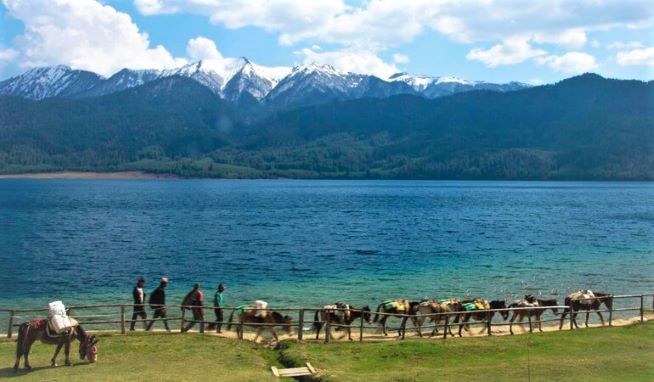
The pivotal of Rara National Park is the pristine Rara Lake, which stands high at the self of 2990m and spreads over 10.8 sq km.( length 5.2 km by breadth 2.5 km ). This tortoise blue lake is surrounded by richly forested hills.Chuchemara Danda ( 4087m ) & the Murmatop hill ( 3400m ) are the two best vantage points to get the magnificent views of the deep blue clear lake and highly forested hillside as well as the snow-capped peaks around it.

Gamgadhi is the district headquarters of Mugu district where exists a small airstrip called “Talcha airport” which is the gate way to the famous Rara Lake for the travelers mainly approaching it from Kathmandu which is then linked via the additional airport in Nepalgunj.

Flora & Fauna :-  Rara Lake, being surrounded by Rara National Park, has unique floral and faunal importance with rare and vulnerable species.It is the home of 51 different species of mammals and 214 species of birds. More than 500 different kinds of flowers and herbs including Rhododendron, the national flower, Black Juniper, Oak, West Himalayan Spruce and Himalayan Cypress are found in this Park. The lake holds 3 endemic fish species ( Schizothorax Macrophthalmus / S. Nepalensis / and S. Raraensis) and one endemic frog known as Rara Lake frog (Nanorana rarica).

Winter visitor water birds such as gadwall (Anas strepera), mallard (Anasplatyrhynchos), northern shoveler (Anas clypeata), common teal (Anas crecca), tufted duck (Aythya fuligula), common golden eye (Bucephala clangula), common merganser (Mergus merganser), common coot (Fulica atra), and solitary snipe (Gallinago solitaria) reside and rest at this lake each year.

Travel Writers’ View :-
Bill Greer :- ( GORP founder ) ::--  " A shimmering blue jewel set in a ring of snowy peaks".Trekkers are recommended to bring their own first aid kit due to the lack of health services around the area.

Since there are no accommodation facilities they may need help from a travel agency. Trekkers need to be self-sufficient as the facilities are not adequate.

Mark Drett :-  "Since the interval of 10 years, I visited again. Before 10 years, we needed to walk 19 days to get there but that has been reduced to 10 hours of gravel road and 4 hours of walk. Not expected but great change. When you get there, you will get the reward for 4 hour long walk."

[ 2 ]  BARDIYA NATIONAL PARK ::  The Bardiya (Bardia) National Park is the protected area and the largest national park in the lowland Terai covering on area of 968 sq.km,and was established in 1988 as Royal Bardia National Park. It is also the most undisturbed national park in Nepal's Terai, adjoining the eastern bank of the Karnali River and bisected by the Babai River in the Bardiya District.

Its northern limits are demarcated by the crest of the Siwalik Hills. The Nepalgunj-Surkhet highway partly forms the southern boundary. Natural boundaries to human settlements are formed in the west by the Geruwa, a branch of the Karnali River, and in the southeast by the Babai River.

The surrounding area of the park was declared as a buffer zone, which consists of forests and private lands. The park and local communities jointly manage the buffer zone. Together they initiate community development activities and manage natural resources in the buffer zones.

This is also the unique national park where the royal Bengal tigers can be observed frequently in every alternate day of your stay here at the park resorts. On May 2008, the Hollywood actor Leonardo Di Caprio shoot the 5 tigers in the single photo frame.

This is one of the Nepalese National Park with rich bio diversity where every year the number of the visitors are continuously increasing. If you are looking to explore something new during you visit this time, then you must experience to taste the flavors of Bardia National Park.

Flora & Fauna  ::  The 70% of the park is covered with the forest ( Sal Trees) and the balance of the park is filled with the mixture of grassland, savannah and riverine forest. There are 839 species of recorded flora.

The park is an excellent habitat for 642 faunal species. The Karnali- Babai river system, their small tributaries and myriads of oxbow lakes is habitat for 125 recorded species of fish. There are Gharial and the mugger crocodiles, 23 species of reptiles and amphibians including snakes & lizard. The park also hosts at least 53 mammals including rhinoceros, wild elephant, Royal bengal tiger, swamp deer, and Gangetic dolphin, black buck. Also there are 407 bird species, among them the Bengal Florican, White-rumped vulture, Peafowl, and Bar-headed geese are the symbolic of the park .

[ 3 ] SHUKLAPHANTA WILDLIFE RESERVE  :: -   Suklaphanta Wildlife Reserve is a protected area in the Terai of the Far-Western Region on the southwest edge of Nepal.It covers the area of 305 sq. km of open grassland, forests, riverbeds and tropical wetlands at an altitude of 174 to 1,386 meters.In the past, the area was a favorite hunting ground for Nepal's ruling class and was declared a Royal Hunting Reserve in 1969. It was only in 1976 when the region was declared as the Royal Shuklaphanta Wild Life Reserve.

The name Suklaphanta was derived from one of the grasslands found inside the reserve. The main grassland called Sukla Phanta is the largest patch of continuous grassland that is spread in an area of about 16 sq. km inside the Suklaphanta Wildlife Reserve.

Flora & Fauna :: --  Reserve is worldwide famous for the herd of Swamp deer, which currently stands at about 2200 individuals. Reserve is recognized for the largest number of tigers found per sq /km in comparison to its small size. This propitious reserve is also the residence of Blue Bull, Barking Deer, Hog Deer, Wild Boar, Leopard, Jackals, Langur, Rhesus Monkey as well as the one horned Rhinoceros.

Some 700 species of flora are estimated in the reserve including 553 vascular plants , 28 fish species and 12 reptiles and amphibian species were recorded. These include Mahseer and Rohu, Mugger crocodile, Indian rock python, Monitor lizard, Indian cobra, common krait and Oriental rat snake. There are 46 mammal species, of which 18 are protected such as the royal Bengal tiger, Indian leopard, sloth bear, swamp deer, elephant and hispid hare.

Similarly , a total of 423 bird species has been recorded. Bengal floricans, Swamp francolin, Jerdon's bushchat, Rufous-rumped grass bird, Chestnut-capped babbler and Jerdon's babbler etc are the main bird species.

Similar Packages