ITINERARY
DAY 01 : ARRIVAL IN KATHMANDU (1400 m )
Welcome reception at Tribhuvan Int’l Airport in Kathmandu and transfer to hotel. Overnight at hotel in Kathmandu. D+A
DAY 02: PREPARATION DAY & EXCURSION IN KATHMANDU
Today your trekking permit is received from the Tourism authorities of Nepal. Meanwhile, you would proceed for a half day sightseeing tour to the heritage sites of Bauddhanath Stupa , Pashupatinath Temple and Soyambhu Mahachaitya hill. Free time at your leisure for the shopping and preparation for the trekking. Tour briefing in the evening. Over night at hotel in Kathmandu. B+L+D+A
DAY 03: DRIVE TO SYABRUBESI
Drive Kathmandu to Syabrubesi. (5 hrs). Camp. B+L+D+A
DAY 04 : TREK TO LAMA HOTEL
Trek to Lama Hotel (2,804m) (6 hrs). Camp. B+L+D+A
DAY 05 : TREK TO LANGTANG VALLEY
Explore the Langtang Valley. Camp. B+L+D+A
DAY 06: TREK TO KYANJIN GOMPA
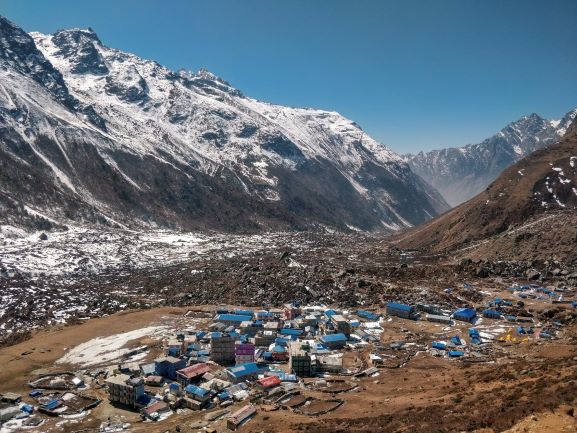
Trek to Kyanjin Gompa (3,800m) (4-5 hrs) Camp. B+L+D+A
DAY 07: EXPLORE KYANJIN GOMPA
Rest and Explore the surrounding area in Kyanjin Gompa Camp. B+L+D+A
DAY 08 : TREK TO GHORE TABLA
Trek to Ghore Tabla (3,048m) (6 hrs). Camp. B+L+D+A
DAY 09 : TREK TO SYABRU
Trek to Syabru (2,140m) (6 hrs). Camp. B+L+D+A
DAY 10: TREK TO SING GOMPA
Trek to Sing Gompa (3,254m) (6/7 hrs). Camp. B+L+D+A
DAY 11: TREK TO GOSAINKUNDA
Trek to Gosaikunda (4,300m) (5/6 hrs). Camp. B+L+D+A
DAY 12: TREK TO THERAPATI
Trek to Therapati (3,600m) (5/6 hrs). Camp. B+L+D+A
DAY 13: TREK TO GUL BHANJYANG
Trek to Gul Bhanjyang (2,130m) (4/5 hrs). Camp. B+L+D+A
DAY 14 : TREK TO CHISOPANI
Trek to Chisopani (2,194m) (4/5 hrs). Camp. B+L+D+A
DAY 15: TREK TO SUNDARIJAL & DRIVE TO KATHMANDU
Trek to Sundarijal (3/4 hrs).Continue drive to Kathmandu same day. Hotel Overnight. B+L+D+A
DAY 16 : A DAY REST IN KATHMANDU
Rest Day in Kathmandu. In the evening enjoy your dinner with the cultural show in the typical Nepalese restaurant in Kathmandu. Overnight at the hotel in Kathmandu. B+L+D+A
DAY 17 : DEPART FROM KATHMANDU TO YOUR ONWARD DESTINATION
Departure Transfer to International Airport. Farewell to Nepal. [ Breakfast ]
--------- End of Tour ---------
Tour Price Includes
-- Transfer between the airport & hotel in Kathmandu .
-- Four (4 ) Nights stay in Kathmandu on twin sharing basis on AP plan ( B+L+D).
-- All surface transportation in private car .
-- Twelve ( 12 ) nights stay at tea house / lodge or tented camp on twin sharing basis on full board
plan ( B+L+D) during the trek.
-- All camping equipment including tent, sleeping bags, mattress, shower and toilet tents and
other amenities etc.
-- Trekking Permit and Langtang National Park Conservation fee.
-- Service of an English speaking trekking guide and the porters during the trek.
-- Kathmandu city sightseeing tour with an English speaking guide, including all entrance fees
as per the itinerary above.
-- 01 Typical Nepalese cultural show with dinner on the final day in Kathmandu.
Tour Price Excludes
-- All International & Domestic Air fares apart from the one mentioned in the cost inclusion section.
-- Personal nature of expenses like telephone calls, bar, laundry, tips etc
-- Travel Insurances and medical expenses.
-- All other additional services that are not mentioned in the cost inclusion section above .
NEPAL TOURIST VISA
-- The “Tribhuvan International Airport “ ( TIA ) is the only international airport of Nepal from where the
Immigration Office grants the Tourist Visa on Arrival for the tourists flying to Nepal .
-- Though you can expect some queues during peak Tourist season, the “On Arrival ' visa procedure is
very quick and simple.
-- If you wish to skip those queues, you can also consider getting Visa from Nepalese Diplomatic Missions
stationed abroad prior to your arrival.
-- If you have obtained visa from Nepalese Diplomatic Missions in abroad , then you must enter Nepal
within six months from the visa issued date. Your total stay is counted starting from the day you enter
into Nepal.
-- Visas obtained on Arrival at the Entry and Exit points are 'Tourist Visas'. They bear multiple Re entry
facility. Tourist Visa 'On Arrival' is the only entry visa to Nepal.
On Arrival Visa Fee at Entry Points ::
15 Days – 30 USD
30 Days – 50 USD
90 Days – 125 USD
NOTE :: Please carry the Cash ( US$ or Euro ) with you . The electronic money is not accepted at all .
Gratis Visa On arrival ( Visa for Free ) ::
-- Children below 10 years except US citizens
-- Up to 30 days for SAARC Citizen (except Afghanistan) visiting Nepal for the first time in a given
visa Year.
-- Non Residential Nepalese(NRN) card holder ( issued by MoFA /Nepalese diplomatic missions abroad).
-- Chinese Nationals
-- Officials from China, Brazil, Russia and Thailand do not need Entry Visa based on reciprocal visa
waiver Agreement
Visa Extension Fee ::
-- Tourist visa extension is done for minimum 15 days with USD 45 and USD 3 per day for additional days.
In the case of delay less than 150 days additional USD 5 per day as late fine.
-- Contact Department of Immigration for extending your visa or changing the category of your visa.
-- Tourist Visa extension can be done from Immigration Office, Pokhara too.
-- Non tourist visa extension can be done only at Department of Immigration (if eligible) for a period of
maximum one year (except business visa).
IMPORTANT NOTE ::-
-- If you are visiting Nepal for the purposes other than Tourism (sightseeing, tour, travel, mountaineering, trekking, visiting friends and families), you should still get ' Tourist Visa' to get into the country. However, you must change the category of visa as per your purpose and length of stay in Nepal from Department of Immigration by producing required documents.
-- Nationals of following countries are requested to acquire Visa prior their arrival from their nearby Diplomatic missions ( Embassies / consulates ) of Nepal Government. (1) Nigeria , (2) Ghana , (3) Zimbabwe , (4) Swaziland,(5) Cameroon, (6) Somalia, (7) Liberia , (8) Ethiopia, (9) Iraq , (10) Palestine , (11) Afghanistan, (12) Syria .
ALTITUDE SICKNESS & REMEDY
-- Altitude sickness, the mildest form being acute mountain sickness (AMS), is the negative health effect
of high altitude, caused by rapid exposure to low amounts of oxygen at high elevation.
-- Altitude sickness occurs when you cannot get enough oxygen from the air at high altitudes.
-- Generally speaking, this brief illness occurs when a person quickly travels from a place with a
low elevation to one with a high elevation - or vice versa.
-- The faster you climb to a high altitude, the more likely you will get acute mountain sickness. The best
way to prevent altitude illness is to ascend gradually.
SYMPTOMS ::
-- This causes typical symptoms such as a headache, nausea, vomiting , light headedness , loss of appetite, and trouble sleeping.
-- The different levels of altitude sickness have different symptoms : Symptoms of mild, short-term altitude sickness also include dizziness, fatigue, shortness of breath, loss of appetite, sleep problems and a general loss of energy.
-- This usually happens above 5,000 feet, though some might not experience altitude sickness until at least 10,000 feet in elevation.
HOW LONG CAN ALTITUDE SICKNESS LAST ?
-- Other symptoms will go away quickly at a lower altitude. Symptoms of moderate altitude sickness usually improve in 24 hours at an elevation that is at least 1,000 to 2,000 feet lower. Symptoms should go away completely within 3 days.
WHAT IS THE BEST REMEDY FOR ALTITUDE SICKNESS ?
Treating Altitude Sickness Instantly ::
-- Stop And Rest Where You Are.
-- Make Sure You're Drinking Enough Water.
-- Then go down to the lower altitude zone as soon as possible.
-- If You Have A Headache, Take Ibuprofen Or Paracetamol.
-- If You Feel Sick, Take An Anti-Sickness Medicine, Such As Promethazine.
-- Do Not Smoke, Drink Alcohol, Or Exercise.
-- Do Not Go Any Higher For At Least 24 To 48 Hours.
-- Once you go down, and after the altitude sickness goes away, get some tea and chocolate.
WHAT MEDICATIONS PREVENT ALTITUDE SICKNESS ?
-- Acetazolamide is used to prevent and reduce the symptoms of altitude sickness. This medication can decrease headache, tiredness, nausea, dizziness, and shortness of breath that can occur when you climb quickly to high altitudes (generally above 10,000 feet / 3,048 meters).
HOW QUICKLY DOES DIAMOX WORK FOR ALTITUDE SICKNESS?
-- To prevent altitude sickness, start taking acetazolamide 1 to 2 days before you start to climb. Continue taking it while you are climbing and for at least 48 hours after you have reached your final altitude. You may need to continue taking this medication while staying at the high altitude to control your symptoms.
HOW MANY DIAMOX CAN I TAKE A DAY ?
-- The recommended dosage is 1 capsule (500 mg) two times a day. Usually 1 capsule is administered in the morning and 1 capsule in the evening. It may be necessary to adjust the dose, but it has usually been found that dosage in excess of 2 capsules (1 g) does not produce an increased effect.
WHO SHOULD NOT TAKE DIAMOX ?
-- You should not use Diamox if you have cirrhosis, severe liver or kidney disease, an electrolyte imbalance, adrenal gland failure, or an allergy to Diamox or sulfa drugs.
INTRODUCTION :
The nearest & best trekking trail
that is situated near from Kathmandu is at Langtang National Park , the
northern region of Kathmandu Valley. Choosing this trail, with your
backpacks, will lead you towards the
Langtang Himala valley, located just south to the Tibetan border.
Enjoy the spectacular
scenery of the Langtang Himal ,Ganesh Himal & Jugal Himal snow peaks, walk through on an open and fertile
valley, discover the amazing
“Rhododendron flower” with the
backdrop of snow-capped mountains, encounter the wild boar and the languor monkey , migratory birds, deer, Tahr and Pika.
“ What will get
permanently printed in your memory ? “-
is the pristine views of the magnificent snow peaks that you would see
while standing by the “Kyanjin Gompa” which is set amidst of the Himalayas.
HIGHLIGHTS ON THE TREK :
Trek Starting Point : Syaphru Besi
( 8 hours drive from Kathmandu )
Trek Ending Point : Sundarijal ( drive back to Kathmandu 2 hours
)
The Highest point altitude
in trekking : 4960 meters
(Chusangma)
Trekking Accommodation Mode : Tea
House / Guest House Or the
Tented Camping
MOUNTAINS YOU CAN
SEE :
(a) Langtang Himal 6581m, (b) Langtang Ri 7246, (c) Lakpha Dorje Kimsung 6745m,
(d) Ganesh Himal 1 -7406m, (e) Ganesh II 7150m, (f) Ganesh III – 7130m, (g)
Yala Peak 5560m, (h) Ganjal Chuli 5844m, (i) Langshisa – Ri 6310m. (j) Morimoto
peak 6750m, (k) Pongen Dopku 5930m, (l) Tembthang 5702m, (m) Salbachum 6707m,
(n) Kyungka Ri 6979m, (o) Langtang Ri 7205m, (p) Chusmodo 6508m.
USEFUL INFORMATION FOR TREKKING
A Typical
Trekking Day ::
-- A typical day’s walk could be minimum
from 4 to 7 hours and involve a multiple
number of ascents and descents along the trail.
It is rare to spend much time at the same level.
-- On an organized camping trek, the day is run to a remarkably tight schedule.
-- Get up at 6:00 AM with a cup of tea, Reset your backpack &
the trekking gear before breakfast, then start walking at 7:00 AM, Stop for
lunch at around 12:00 PM..
-- Restart your trekking journey after the lunch and stop walking by 04:00 PM.
-- The dinner is served around 06.30 PM and followed by a briefing for the next
day’s trekking plan and finally it is time to go to sleep.
-- Please be informed that this time table may be adjusted according to
weather conditions, availability of camp sites, water supply etc.
-- To ensure that you will enjoy your trek whole heartedly, we would like to
advise you about the following highlighted points which should seriously be
taken into account:
Food
and Water
--
Lodges and tea houses are carefully chosen by our trekking staff while
passing through the trekking trail. We will make sure that excellent food will
be provided to you and that water is boiled or adequately treated, as this is
one of the basic rules for healthy trekking.
-- On a camping trek, your only concern with food is sitting down to eat it !
The porters carry all the food along with them and there will be a cook with
assistants who can turn out meals of often stunning complexity, like baking a
cake.
Money
Everything is included in the price of
the trek, except for the purchase of water and soft / hard
drinks so we advise you to always carry Nepalese rupees during your trek. The
amount to be carried depends on the area and the duration of the trek.
Be
A Responsible Trekker
Although trekking in the Himalayas
plays a vital role in the economy of many mountain areas, it also may have a
negative impact which has become a major concern.
Minimize Your Impact to The
Flora And The Fauna
From an ecological point of view,
always carry your rubbish with you, drink treated water instead of mineral
water in order to reduce the use of plastic bottles.
Be
Respectful to Nepalese Culture & Tradition
-- From a human point of view, please
respect Nepalese culture and traditions. It is a good thing before leaving for
the trek to
have a look at the “Do and Don’t”
since an inappropriate behavior, though considered normal in Western countries,
could severely shock or hurt local
people.
Ask
Permission From The Person Before Photographing Them
-- Please do not give money or sweets to
the children directly on your trip, as this encourages them to beg and may
contribute to dental problems.
-- If you would like to give something back, you can assist with our charity
work by volunteering or giving a donation.
Trekking
17 Days
US$ 1195.00 ( mini. 02 Pax ) Per Person